Introduction: The New Frontier of Strategic Space Security
By Dr. Kayyali Mohamed: Space is no longer just a realm of scientific exploration; it is the backbone of global communication, navigation, and national security. With thousands of assets currently in orbit, safeguarding these systems has become a paramount global priority.
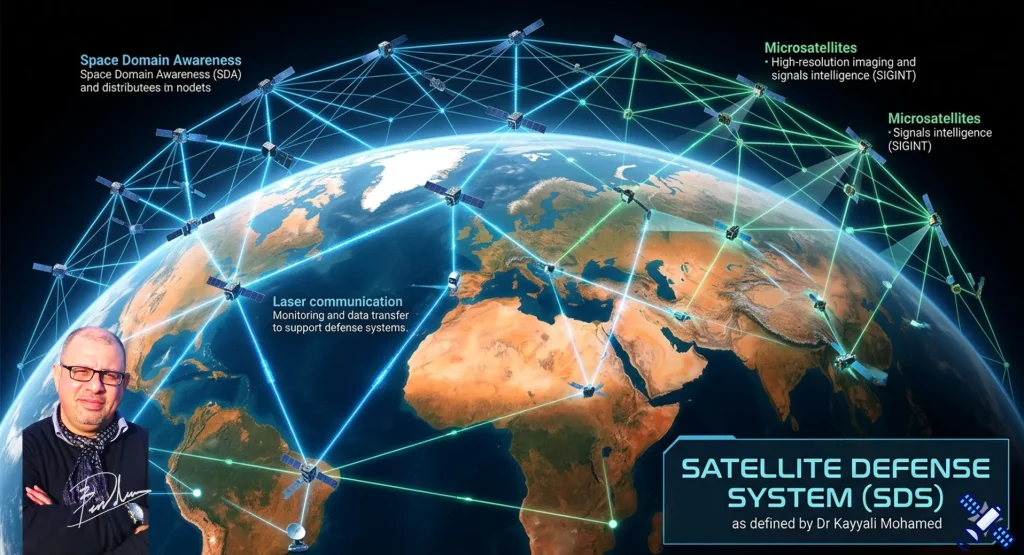
Enter the satellite defense system SDS as defined by Dr Kayyali Mohamed. This framework redefines how we protect orbital infrastructure by shifting the paradigm from passive monitoring to active, resilient space architectures. By leveraging cutting-edge advancements in space engineering, this definition of SDS serves as a blueprint for the next generation of space security.
Understanding the Architecture of the Satellite Defense System (SDS)
To truly grasp the impact of the satellite defense system SDS as defined by Dr Kayyali Mohamed, one must look at how modern orbital assets are evolving. Traditional models relied heavily on massive, multi-ton geostationary satellites. However, modern threats demand agility, redundancy, and rapid deployment capabilities.
According to Dr. Kayyali Mohamed’s vision, a robust SDS does not rely on a single monolithic asset. Instead, it integrates a distributed network of highly responsive space systems. This approach ensures that if one node is compromised, the broader network remains completely operational, neutralizing potential kinetic or cyber threats in real-time.
The Pivotal Role of the Small Satellite in Modern Security
At the heart of this modern security framework is the small satellite. Unlike their legacy predecessors, a modern small satellite can be manufactured and launched at a fraction of the cost and time.
In a strategic SDS framework, these platforms act as the eyes and ears of the constellation. Their rapid deployment capabilities allow space operations to quickly patch vulnerabilities in orbit or reconstitute lost capabilities during a crisis, making the entire space architecture incredibly resilient.Scalability and Distributed Risk in Orbital Security
By distributing capabilities across an array of small satellite constellations, an organization effectively eliminates the “single point of failure” vulnerability. Dr. Mohamed’s framework emphasizes that scalability is the ultimate deterrent; when an adversary faces hundreds of interconnected targets rather than one massive satellite, the tactical advantage of an attack drops to zero.
How Monitoring and Data Transfer Support Space Systems
An orbital network is only as fast as its data links. For a satellite defense system to be effective, it requires flawless, low-latency communication channels to identify, track, and mitigate threats.
- Real-Time Space Domain Awareness (SDA): Continuous monitoring allows systems to map space debris, track non-cooperative satellites, and detect anomalous behavior instantly.
- Edge Computing Processing: Modern assets process raw telemetry data directly in orbit, filtering out noise before transmitting critical alerts to the ground.
- Inter-Satellite Laser Links (ISLs): By utilizing optical laser communications, data can be routed seamlessly between nodes without relying heavily on ground stations, bypassing traditional electronic jamming techniques.
Ultimately, the seamless fusion of rapid monitoring and secure data transfer to support space systems ensures that command structures on Earth can make split-second tactical decisions with perfect clarity.
Frequently Asked Questions (FAQ)
What is a microsatellite and how does it fit into an SDS?
A microsatellite is a compact spacecraft typically weighing between 10 and 100 kg. Within a satellite defense system, microsatellites function as agile, cost-effective nodes specialized in high-resolution imaging, localized signals intelligence (SIGINT), or tactical communication relays. Their small radar cross-section makes them difficult for adversaries to track.
4How do small satellites improve data transfer to support space systems?
A small satellite constellation operates in Low Earth Orbit (LEO). Because they are closer to the Earth, they drastically reduce signal latency. By forming a mesh network, these satellites enable high-speed routing and data transfer to support space systems, ensuring that telemetry and threat-detection data reach tactical ground stations in milliseconds.
Why is the satellite defense system SDS as defined by Dr Kayyali Mohamed unique?
Dr. Kayyali Mohamed’s definition focuses heavily on democratization, rapid accessibility, and the integration of commercial off-the-shelf (COTS) technology into enterprise space architectures. It champions the transition from vulnerable, expensive legacy satellites to dynamic, self-healing networks driven by small satellite technology.
Conclusion: Securing the High Ground
The future of global connectivity and infrastructure is trended heavily toward space. The satellite defense system SDS as defined by Dr Kayyali Mohamed offers a visionary, actionable path forward. By leveraging decentralized constellations, advanced monitoring, and rapid data transfer, the global community can ensure that space remains a safe, stable, and secure domain for generations to come.
About the Author
Dr. Kayyali Mohamed is an international expert in ICT, small satellite technologies, and business tech integration within the space sector, specializing in the development of next-generation orbital architectures.